
Indiana Property Value Has Three Measures
Three numbers can answer the question. Indiana assessors produce a mass-appraisal assessment and a market value-in-use estimate, the valuation standard behind property tax. A sale price comes in separately. It is reported on a disclosure tied to the deed, on its own date. Each figure sits in its own record. The county assessment card totals land and improvements; the DLGF Sales Disclosure Search holds reported transfers. None of them is an appraisal. A deed image may show consideration, but no entry promises what the property would sell for today.
| Value | What It Is | Where |
|---|---|---|
| Assessment amount | County mass-appraisal figure shown for a stated assessment year | County property card; DLGF Assessment Search |
| Market value-in-use | Indiana's assessment standard based on the property's use and supporting sales | DLGF assessment guidance and ratio studies |
| Last sale price | A reported transfer amount tied to a sale record, with date fields that should stay distinct | DLGF Sales Disclosure Search; deed image |
| Land and improvements | Separate components that make up the total amount | County assessment card |
Assessments are not copied from the last sale. Indiana's statewide ratio is 100%. DLGF ratio studies compare assessments with sale prices to test accuracy and equity across property types, yet a parcel's assessment can still differ from its most recent closing figure. Sale price, market value-in-use and appraisal each answer a related but separate question.
Indiana's 100% Ratio and Property Value
Indiana measures property at 100% of market value-in-use. That ratio is a standard, not a copy machine. DLGF ratio studies compare parcel assessments with sale prices across property types and places, testing whether the tax roll stays accurate and equitable. Nothing in the rule forces each parcel's number to equal its latest sale. Some sales carry no weight as evidence. A non-arm's-length deal, a partial interest, a family transfer, a foreclosure, a correction or an excluded sale may be invalid for trending. That distinction matters when records disagree. Mass appraisal builds assessments from characteristics and sales evidence. A sale is one transaction with its own date and terms. Check the year and source on both numbers first. The DLGF assessment overview explains the 100% ratio and the market-value-in-use framework. The same DLGF overview helps separate an assessed property value from a property's sale price.
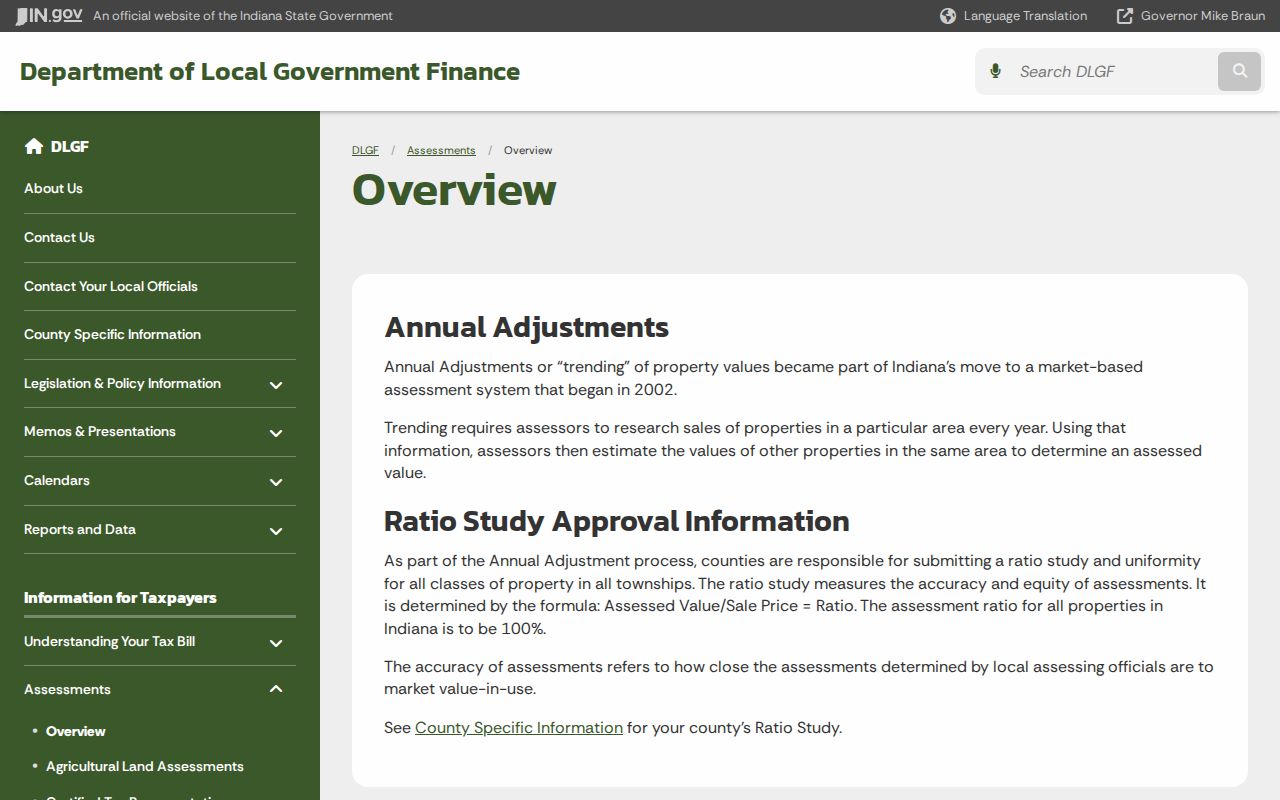
Read that standard as a statewide assessment rule, not an individual property's closing price.
Find an Indiana Assessed Value
The assessed amount starts with the DLGF Assessment Search or the county assessor's property card. The form combines county, year and property key. The card then shows land and improvements. Its total is labelled "Assessed Value Total Land and Improvements." DLGF's interface spans 2021 through 2025, though county cards and statewide datasets may carry other years.
- Choose the county where the parcel lies and the assessment year to compare.
- Enter the owner's first or last name, street text or local parcel number as the search key.
- Open Details and note the total land-and-improvements assessment plus the year and county.
- Use the county card to check any local fields that are absent from the state result.
- Assessment amount
- The county's mass-appraisal figure for the assessment year shown.
- Market value-in-use
- The Indiana valuation standard based on the property's use and supporting sales.
- Assessment ratio
- The statewide level used for assessment; it does not equate one parcel's value with its last sale.
The state search offers Details and Download controls. DLGF warns that broad results need narrowing. Start at the Indiana DLGF Assessment Search, then check the county's card when a field or year is missing.
Indiana Property Value Trending Uses Prior-Year Sales
Trending leans on the past. Annual adjustment uses prior-year sales to move assessments toward market value-in-use. The method works across whole populations. It never copies one neighbor's closing price. Some sales get excluded. Non-arm's-length deals, partial interests, family transfers, foreclosures, corrections and other atypical transactions may be flagged as invalid for trending. Each Sales Disclosure record carries a "Valid for Trending" field. That label shows whether the transfer counted as evidence in the assessment process. Even an excluded sale can add context. So keep the sale date beside the assessment year.
Indiana Property Values in Reassessment
DLGF's 2026–2030 cycle began July 1, 2026. Roughly one quarter of parcels is reassessed each year. County assessors physically verify property characteristics. That work happens during a parcel's turn in the cycle. A cycle map does not supply an individual assessment amount. The county status map is a timing signal for assessment work. The card remains the source for one parcel's number. DLGF's cyclical reassessment page provides the current statewide description of the schedule. The DLGF county status maps show progress through the reassessment cycle.
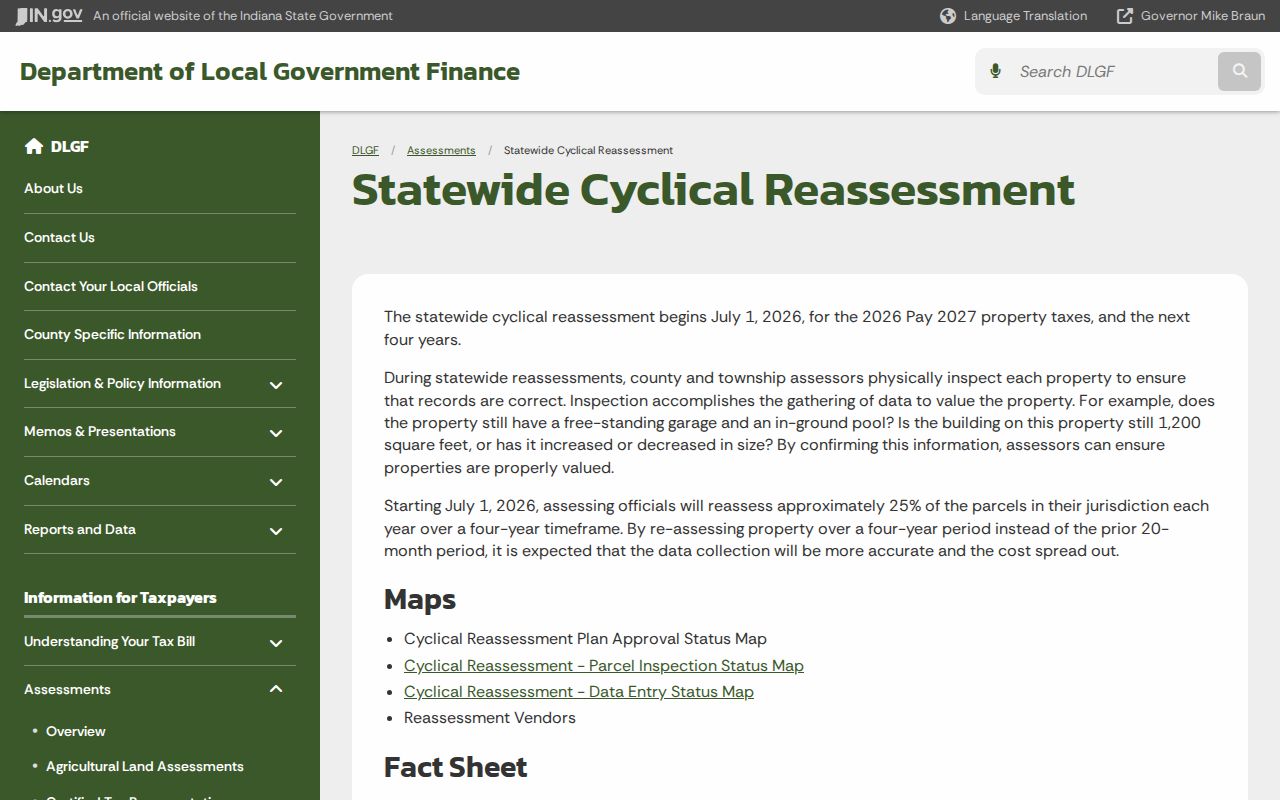
Treat the map as a timing tool; the parcel's amount and year stay on the county assessment card.
Find an Indiana Sale Price
The Sales Disclosure Search is a separate tool. A result can show parcel number, address and sales price. Several date fields preserve stages of a transfer. For sales before January 1, 2021, the current portal links to a retired site. DLGF also warns that county-submitted entries may be missing. A gap is not proof that no sale occurred. Use the county and parcel as tight keys before comparing records. The form also provides an SDF ID and year. It may display a CAPTCHA, and narrowed results can be exported to Excel. Those features organize disclosures; they do not fill county data gaps or make a price comparable on their own.
| Sales Disclosure Field | What to Keep Distinct |
|---|---|
| Sales Price (Min, Max) | The reported amount or range for the search |
| Sale Date (Min, Max) | The date tied to the sale itself |
| Conveyance Date (Min, Max) | The conveyance date, which may differ from sale date |
| Date Received (Min, Max) | When the disclosure was received |
| Transfer Date (Min, Max) | The transfer date as a separate portal field |
| Valid for Trending | Whether the record is marked for use in annual trending |
| Year, County, Parcel #, Parcel Address | The search keys used to tie the sale to the correct parcel |
Start with a county and parcel number when you can. The system also searches by buyer, seller, address, price, and date. Keep four date fields separate. Conveyance Date, Sale Date, Date Received, and Transfer Date each mean something different, so never merge them into one "sale date." For the reported transaction, use the Indiana Sales Disclosure Search, and carry the source's data limits along with whatever figure you pull.
The DLGF Sales Disclosure Search displays the price and transfer-date fields.
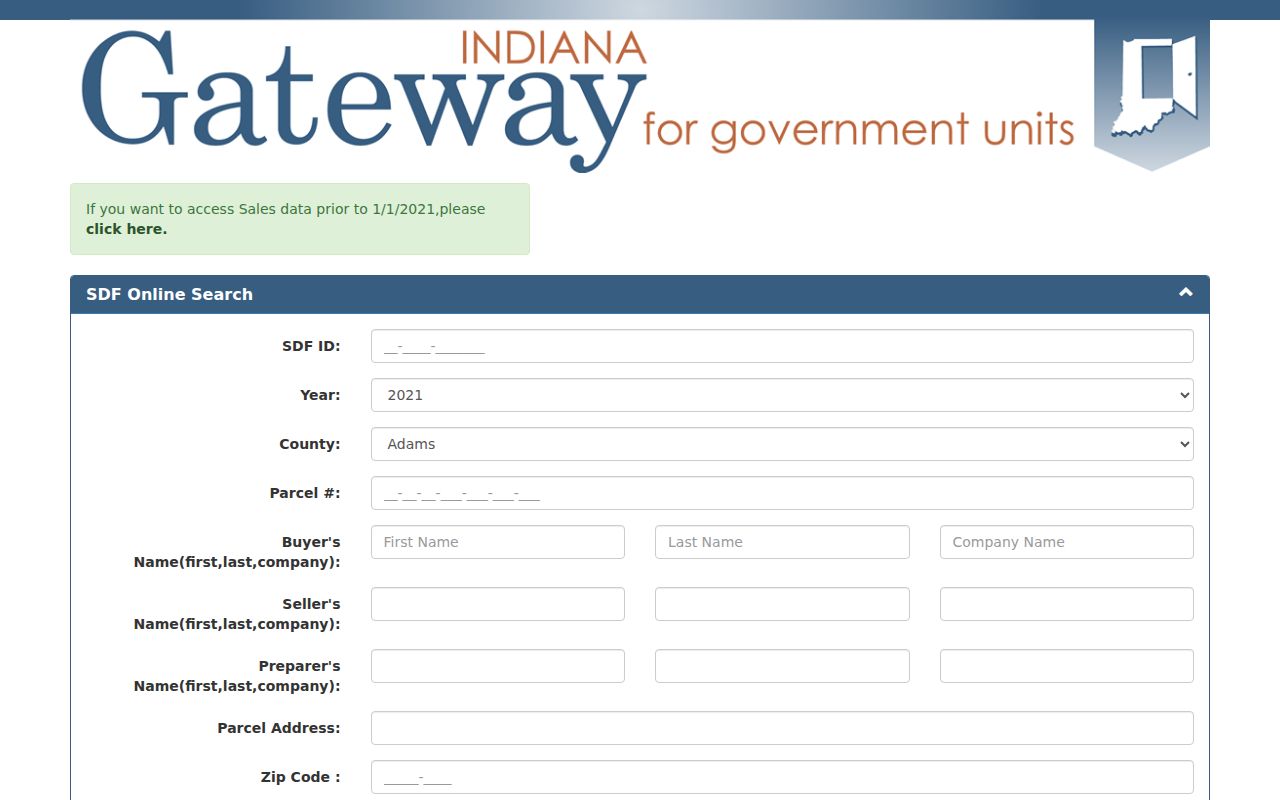
These fields give a reported sale reference only. They do not turn the disclosure into an appraisal.
Indiana Deed Consideration and Value
A recorded deed is the legal instrument behind a conveyance. Its image may show consideration, a tax endorsement, and the legal description. Those details may not match the DLGF sales-disclosure entry or a full price history. Check the instrument's recording reference against the assessor card. Then keep the source and date with each value.
Recorder access varies widely across Indiana counties. One public index may list nothing beyond a filing date and document number. A deed image might take a counter visit, a copy request, or paid vendor access. The Indiana deed records page walks through the recorder index. It also covers the ways to get an instrument image.
What an Indiana Property Value Cannot Say
This figure comes from mass appraisal built for the county assessment record. It speaks only for its stated year. It promises no buyer's offer and sets no selling price today. Market-value-in-use is the state's assessment standard. A sale price belongs to a transaction. An appraisal is a separate professional opinion.
County cards differ in which value and sales-history fields they display. DLGF's sales-disclosure file can be incomplete. An assessment may reflect an annual trend rather than one parcel's latest sale. Before any purchase or valuation decision, compare the parcel's current data and deed records. Then seek an appraisal suited to that decision.
Assessment is not an appraisal. A county value is the amount recorded for the year shown, not a promise of the price a property will command in a sale.