
Indiana Deed Records and Deed Types
Indiana deed records live with the county recorders who accept and index each instrument. Coverage and portal choices vary by county. A good search starts with a party name. It then uses the parcel's legal description and document reference to confirm the right land. Address search is not offered everywhere, so an assessor or GIS map may bridge a street address to the deed index. A deed records the parties and interest in that instrument alone. It does not certify a full title history or rule out later claims.
| Deed Type | What It Does | Common Use |
|---|---|---|
| Warranty deed | Conveys the described interest with the deed's stated warranties. | Reviewing a conveyance and the parties' stated terms. |
| Special-warranty deed | Conveys an interest with a limited warranty. | Checking the limits written into the instrument. |
| Quitclaim deed | Transfers whatever interest the grantor held, without the same warranty. | Tracing a change in claimed interest. |
| Executor or personal representative deed | Records a transfer made under estate authority. | Following an estate-related transfer. |
| Sheriff's deed | Records a transfer following a court-ordered sale. | Connecting a sale to a later owner entry. |
| Correction deed | Changes an earlier deed detail such as a name or description. | Reconciling a corrected record with its source. |
Not every index entry is a deed. A mortgage encumbers property without transferring ownership. An assignment changes the secured party. A release or satisfaction clears an encumbrance. Plats, easements, affidavits, liens, annexations, cemetery deeds, and miscellaneous instruments can sit beside conveyances in the deed records. Identify the document type first, before reading a result as an ownership change.
Indiana Recorder Index Access Tiers
County access differs across Indiana. Some recorders offer a free filing-only index. It lists a filing date and document number with no image. Others route users to Fidlar Tapestry for pay-per-search access, or to Laredo for account-based searching and images. A counter terminal can show a different range than a free public webpage. Check the county recorder's access page before assuming online results are complete.
Wabash County's recorder page documents a free index and paid image options as one local example. Its choices apply to Wabash alone. The official Indiana State Board of Accounts recorder guidance explains the office's indexing and inspection duties. It covers indexing duties. It also covers inspection duties. The image below shows a county access page as a concrete example. Then verify the portal and coverage for the county where the parcel lies.
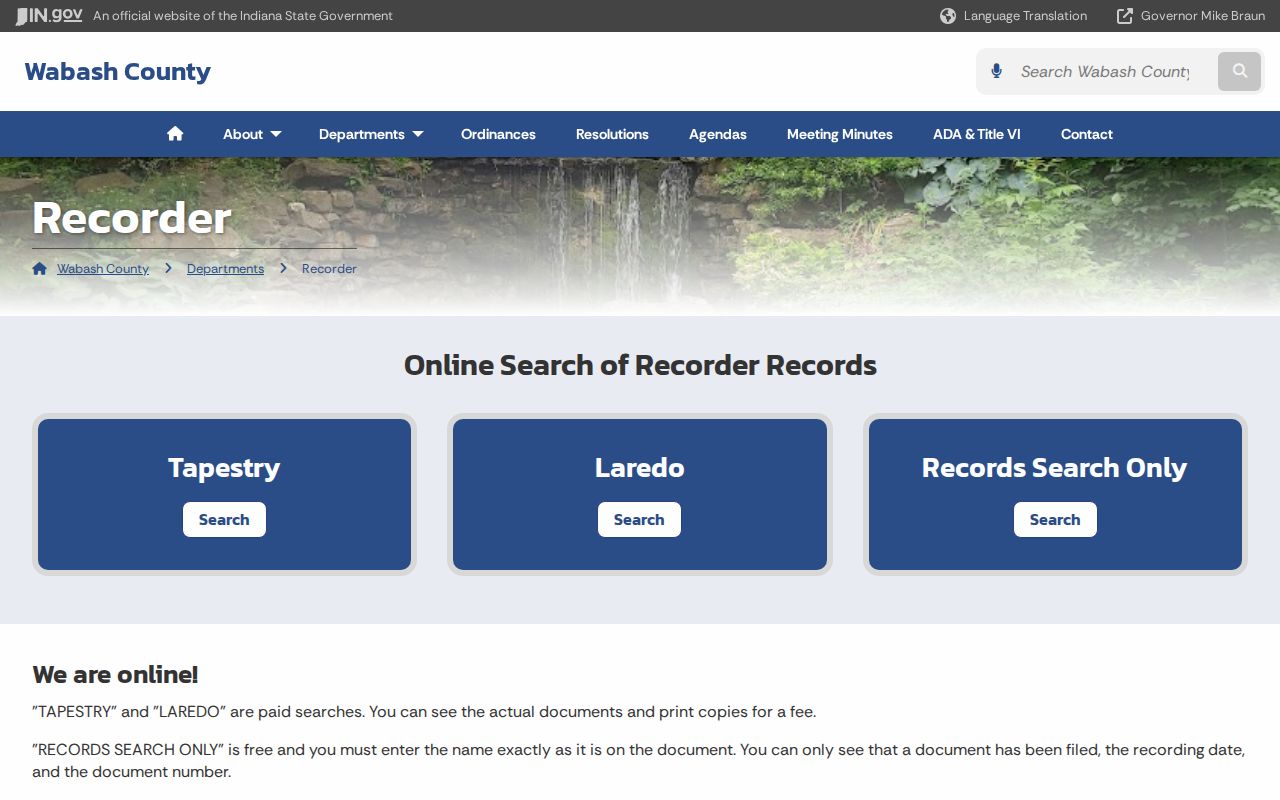
The tier difference matters when a search returns a filing reference without the instrument. A free result can locate the deed. Viewing the image or ordering a certified copy follows a separate county process.
Indiana Deed Index Search Fields
Search fields vary by county vendor. Party name is the common starting point in nearly every deed index. Some portals narrow results by recorded-date range, document type, instrument number, book and page, or legal-description text. Address and parcel-number searches are not universal. Use the assessor or county GIS map to find a legal description when an address fails.
| Field label or mode | Type | Required | Indiana county variation |
|---|---|---|---|
| Party name / last name | Text | Usually required for a name search | Exact spelling may be needed in a free index; search grantor and grantee separately where offered. |
| First or middle name | Text | Optional | Useful for same-name separation; not always indexed separately. |
| Recorded date from/to | Date pair | Optional | Labels vary; use to narrow a common surname. |
| Document type | County menu | Optional | May include deed, mortgage, assignment, release, lien, plat, easement, affidavit, judgment, or other classes. |
| Instrument number or book/page | Text or paired fields | Optional | Newer systems may use an instrument number; older books may use book and page. |
| Legal description or subdivision | Text | Optional | May accept lot/block, section-township-range, or description words. |
| Parcel/key number | Text | Optional | County key format varies; some recorder portals do not accept a parcel search. |
| Address | Text | Optional or unavailable | Address search is not universal; use assessor/GIS for the legal description. |
Tippecanoe County's recorder page reports data and image access beginning January 16, 1970. That date is a Tippecanoe example only and does not apply to another county or record class.
Indiana Grantor-Grantee Search
An Indiana recorder index is a party index, not a parcel history in every county. A grantor conveys an interest. A grantee receives it. Start with the tax-roll owner's name as a grantee, then inspect candidate deeds and match the legal description. The deed's grantor is the earlier link. Repeat the grantee search for that prior party to step back through the recorded chain.
- Search the current tax-roll name as grantee near the likely acquisition date.
- Open each likely deed and compare its legal description with the parcel.
- Record the grantor, then search that name as grantee for the prior conveyance.
- Continue backward, noting instrument references and where online coverage ends.
- Grantor
- The party conveying the interest named in an instrument.
- Grantee
- The party receiving the interest named in an instrument.
- Chain of title
- The ordered sequence of recorded transfers tied to the same land.
- Book/page and instrument number
- Two county reference methods for locating a recorded document; older books may use page citations while newer systems often use an instrument number.
Names deserve the same care as the parcel match. Try the exact name from the deed, plus initials, punctuation-free forms, married or maiden names, "estate of" labels, trustee or personal-representative tags, and common LLC suffixes. The image can also reveal an "also known as" name or a prior-document citation the index never cross-linked.
Indiana Deed Numbers and Land Descriptions
The instrument image often carries what the index row omits. That includes exact party names, the legal description, execution and recording dates, prior-document references, and any tax endorsement. Keep the document number or book/page with the county and recording date. Those details let a later searcher return to the same deed record. This holds true even after a vendor changes its screen layout.
A street address is a weak key for older deeds. A legal description may rely on subdivision, lot and block, section-township-range, or metes-and-bounds language. The parcel may also have split, merged, or changed its address. Match the full land description and the cited prior deed. Do not trust a similar owner name or a modern map label.
When reviewing an image, capture the document type, recording date, instrument number or book/page, parties, and the full legal description. An index date usually refers to recording. The instrument may show a separate execution or conveyance date. Keep both dates. That prevents a later researcher from treating the filing date as the day the parties signed or transferred the interest.
Indiana Deed Book Coverage
Indiana has no single statewide start date for online deed records. Coverage varies by county recorder. Tippecanoe offers data and images from January 16, 1970. Cass provides images from January 1, 1982. Clark's deed and miscellaneous index begins in November 1999. These dates describe what each county's online source covers. They do not mark where its physical deed books actually begin.
Older instruments often survive beyond a portal's reach. The chain may continue in recorder deed books and indexes. It may also survive on microfilm, in county archives, through an IARA transfer, or in a digitized FamilySearch collection. The county recorder is the first contact for books that were never transferred. No verified courthouse-fire or deed-book-loss event appears in the record. So an online gap should never be labeled a known loss.
Indiana Property Fraud Alert Limits
Some counties offer a name-monitoring notice when a matching name appears in newly recorded documents. Hamilton County's 2025 land-record system change required subscribers to re-enroll, illustrating that an alert program can depend on a local vendor and can change during a migration. A name match is a prompt to inspect the instrument, not proof that a filing concerns the property or person you have in mind.
Use the instrument, not the alert alone. A recorder alert does not establish clear title and does not monitor every lien, court judgment, or state tax claim. Verify the document number and legal description with the county recorder.
A question about an actual title chain or lien status goes deeper. Indiana recorder guidance does not require staff to search or certify that no lien exists. A qualified title professional may be needed for a formal conclusion.
Get an Indiana Deed Copy
After an index result is matched to the right parcel, pull the image from the county portal if one exists. Otherwise, inspect the record at a public counter terminal. You can also request a copy from that county recorder. Indiana's recorder fee schedule under IC 36-2-7-10 sets a plain standard-size copy at $1 per page. An oversized copy runs $2 per page, and acknowledgment or certification costs $5. Vendor image charges and county supplements may add costs, so confirm the local office's current payment and delivery rules.
A written request should name the particular instrument. Identify the county, grantor or grantee, and the approximate recording date. Include the document type and instrument number, or book and page when known. If that reference is unknown, give the legal description. Then ask whether the office offers self-service index access or can explain its search options. For mailed requests, follow the recorder's instructions on payment and return delivery.
Recorded is not guaranteed. An Indiana deed index shows recorded entries; it is not a title opinion. It cannot establish that no unrecorded interest or later claim exists.